Art and Design
Art and Design
At St Willibrord’s, we want pupils to develop the knowledge, skills and confidence to explore ideas, experiment with materials and techniques, and create purposeful and personal works of art.
Our Art and Design curriculum is based principally on the Kapow Primary scheme. Units are selected and sequenced across Years 1–6 to ensure that pupils progressively develop their artistic knowledge, practical skills and understanding.
How our Art and Design curriculum develops
Across the curriculum, pupils develop their learning through five interconnected areas:
-
Generating ideas – exploring starting points, responding to stimuli and increasingly developing their own creative ideas.
-
Using sketchbooks – recording observations, exploring materials and techniques, developing ideas, planning outcomes and evaluating work.
-
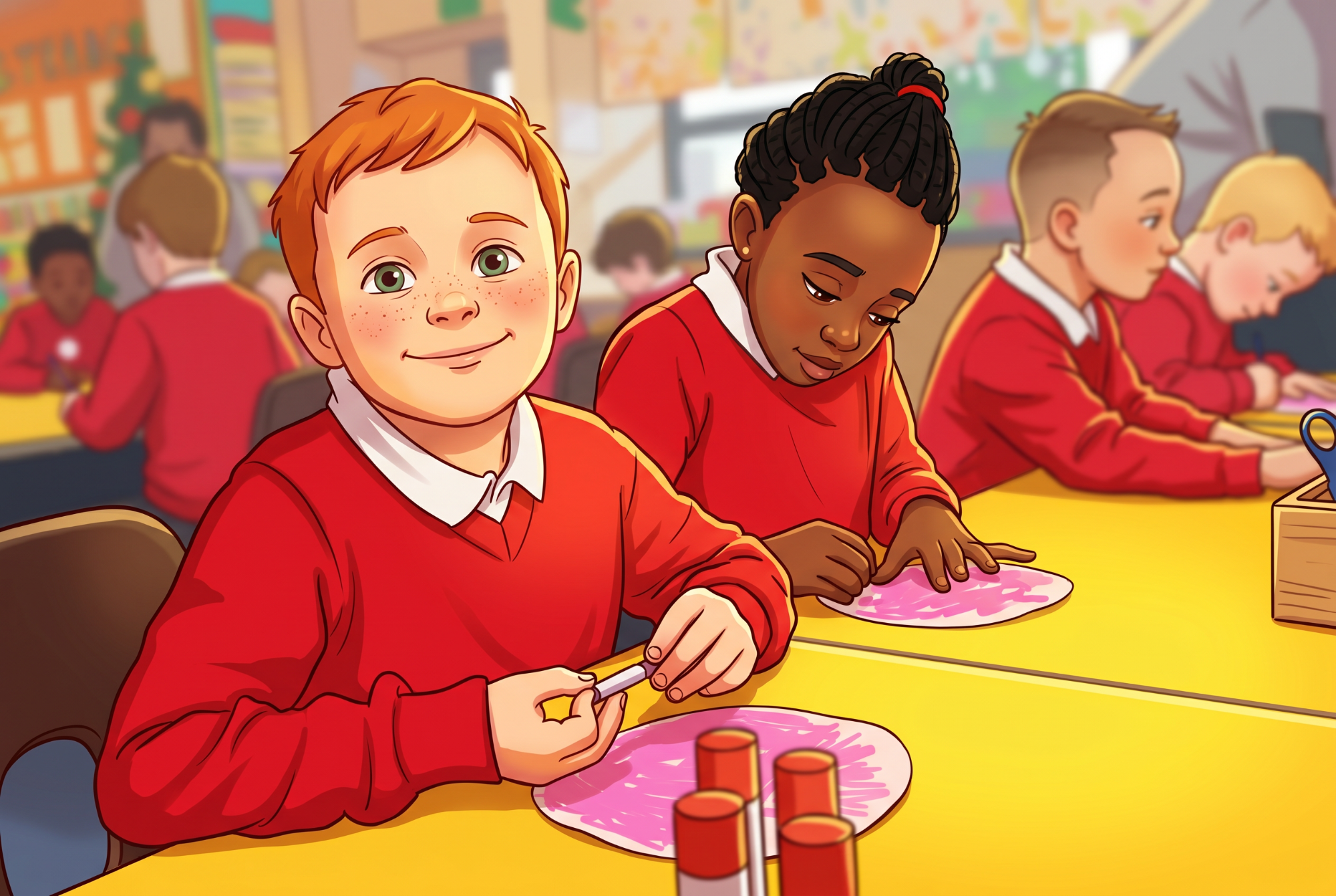
Making skills – developing increasing control and confidence when drawing, painting, working with mixed media, sculpture, craft and other materials.
-
Knowledge of artists – studying a range of artists, craftspeople, architects and designers and considering how their work is influenced by different ideas, cultures, places and periods.
-
Evaluating and analysing – discussing their own and others’ artwork, using increasingly precise subject vocabulary and reflecting on how work can be developed and improved.
Pupils also develop their understanding of the formal elements of art, including colour, form, line, pattern, shape, texture, tone and space.
Progression through the school
Learning is carefully sequenced so that pupils revisit important artistic knowledge and skills with increasing complexity.
In Year 1, pupils begin by exploring line and shape, developing control when painting and working with paper to create three-dimensional forms.
In Year 2, pupils develop their understanding of tone and texture, build their colour-mixing skills and work with clay to create three-dimensional pieces.
In Year 3, pupils extend their drawing skills, explore texture through paint and collage, create work inspired by Ancient Egyptian art and develop their understanding of abstract three-dimensional form.
In Year 4, pupils develop greater control of tone, texture and proportion, explore light and dark through painting, work with a wider range of sculptural materials and develop their understanding of craft and design.
In Year 5, pupils use drawing to explore depth, emotion and movement. They develop expressive approaches to portraiture, investigate installation art and explore architecture through craft and design.
In Year 6, pupils use drawing to communicate increasingly expressive ideas, develop their understanding and control of watercolour and create sculptural work that explores memories and personal responses.
Developing independence as artists
As pupils move through the school, they are expected to make increasingly independent artistic decisions.
They learn to:
-
select materials and techniques for a particular purpose;
-
test and refine ideas before creating a final outcome;
-
use sketchbooks to research, explore and develop ideas;
-
explain the choices they have made;
-
respond to and evaluate the work of artists and their peers;
-
reflect on their own work and consider how it could be improved.
Art is therefore not simply about producing a finished piece. The process of exploring, practising, questioning, developing and evaluating is an important part of pupils’ learning.
Inclusion
Our Art and Design curriculum is ambitious for all pupils. Teachers adapt teaching, resources, equipment, modelling and support where necessary so that pupils can access the same important artistic knowledge and develop their practical skills from their individual starting points.
Our curriculum plans
Further information about the Art and Design units taught in each year group can be found within our Curriculum by Year Group plans.
If you would like further information about our Art and Design curriculum, please contact the school.